This is especially useful during fat loss. Diets rarely fail because people do not understand what a calorie deficit is. They often fail because hunger, tiny portions and snack cravings become too hard to manage.
In short: volume eating helps you eat bigger, more satisfying meals without blowing up your calorie target.
Quick summary: the most important points
- Volume eating focuses on foods with low energy density.
- Low energy density means more weight or volume for relatively few calories.
- Water, fiber and vegetables can increase meal volume.
- Protein still matters because satiety and muscle retention should go together during fat loss.
- Very calorie-dense foods are not forbidden, but they need more conscious portions.
- Volume eating is not a crash diet. It is a meal-building principle.
- Useful foods include vegetables, fruit, potatoes, soups, salads, legumes, quark, skyr, lean meat, fish, tofu and low-fat dairy.
- The best effect often comes from combining protein + fiber-rich foods + water-rich volume + a sensible amount of fat.
1) What does volume eating mean?
Volume eating is not about eating only salad or filling yourself with cucumber. It is about building meals that feel satisfying while still fitting your calorie target.The central concept is energy density.
Energy density describes how many calories a food provides for a given weight, usually kcal per 100 g.
Examples:
- 100 g cucumber provides very few calories.
- 100 g oil provides a lot of calories.
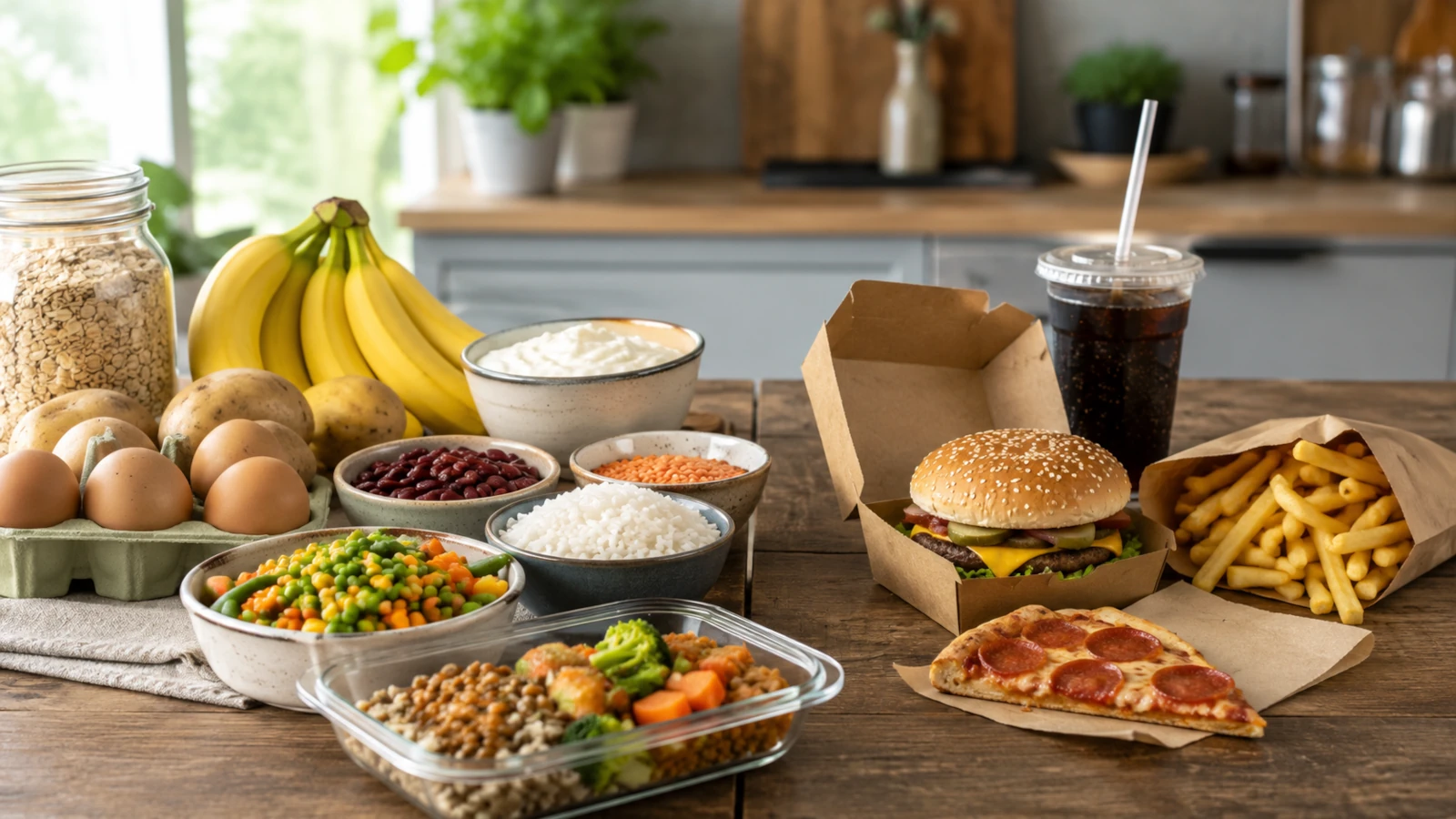
- 100 g potatoes provides far fewer calories than 100 g chips.
- 100 g skyr is often more filling than 100 g candy.
Volume eating does not mean eating only low-calorie foods. It means portioning calorie-dense foods consciously and combining them with filling, high-volume foods.
2) Why volume eating helps with fat loss
For fat loss, you need a calorie deficit over time. This article explains the basics: Calorie deficit explained simplyThe problem is that a calorie deficit can increase hunger. Hunger is one of the main reasons people quit diets.
Volume eating helps exactly there. Instead of trying to survive on tiny portions, you make your meals bigger, more filling and easier to repeat.
It can help because:
- your plate looks fuller
- you usually chew more
- your stomach gets more food volume
- fiber can make meals more filling
- protein-rich foods add another satiety signal
- you feel less like you are “on a diet”
3) The three main levers: water, fiber and protein
Volume eating works especially well when you combine three things.Lever 1: water-rich foods
Many fruits and vegetables contain a lot of water. Water adds weight and volume without calories.Typical examples:
- cucumber
- tomatoes
- zucchini
- peppers
- broccoli
- leafy salads
- berries
- melon
- soups and stews with lots of vegetables
Lever 2: fiber
Fiber can support satiety, digestion and meal structure. It is found mainly in vegetables, fruit, whole grains, legumes, nuts and seeds.For more detail, read: Fiber: gut health, satiety and net carbs
Lever 3: protein
Protein is especially important during fat loss because it supports muscle retention and many protein-rich meals are filling.Good next reads:
A strong diet-compliance combination is often: protein + fiber + water-rich volume.
4) What is energy density?
Energy density describes how many calories are packed into a certain amount of food.Simple classification:
- low energy density: high volume, relatively few calories
- medium energy density: moderate, portion-dependent
- high energy density: small amount, many calories
- vegetables
- many fruits
- broth- or water-based soups
- potatoes
- quark, skyr and low-fat dairy
- lean meat and fish
- cooked legumes
- oils and butter
- nuts and nut butter
- cheese
- chocolate
- chips
- pastries
- fried foods
- sauces with lots of oil, cream or sugar
5) Good volume foods for fat loss
Vegetables
Vegetables are the classic choice because they provide volume, micronutrients and often fiber.Very practical options:
- broccoli
- cauliflower
- zucchini
- peppers
- tomatoes
- cucumber
- spinach
- mushrooms
- carrots
- salad
- frozen vegetable mixes
Potatoes
Potatoes are often underrated in diets. They provide a lot of volume, are relatively low in calories per 100 g and are very filling for many people.Preparation matters. Boiled potatoes or oven potatoes are very different from fries or chips.
Soups and stews
Soups and stews can be very filling when they combine vegetables, protein and a sensible carbohydrate source.Examples:
- lentil soup with vegetables
- chicken vegetable soup
- potato vegetable stew
- chili with beans and lean mince or soy mince
- tomato soup with a skyr or cream-cheese topping
Fruit and berries
Berries are practical for many diets because they provide relatively few calories and a lot of volume.Useful choices include:
- strawberries
- raspberries
- blueberries
- apple
- orange
- watermelon
Quark, skyr and yogurt
These foods are especially useful when you want to combine volume and protein.Example: quark or skyr with berries, sweetener or a little jam, plus oats or oat bran. This is usually far more filling than many small sweets with similar calories.
Legumes
Lentils, beans and chickpeas provide fiber, carbohydrates and some protein. They are not always extremely low in calories, but they are often very filling.6) Foods where portions are easy to underestimate
A common dieting mistake is not always eating “the wrong food”. It is often the portion size of very energy-dense foods.Typical calorie traps:
- oil in the pan
- nut butter
- nuts
- cheese
- cream sauces
- pesto
- mayo
- chocolate
- chips
- granola
- protein bars
Practical trick: Do not ban them. Dose them.
Example: instead of building a meal with lots of oil, cheese and little vegetables, use a clear protein source, plenty of vegetables, a filling side and only a conscious amount of oil or cheese for taste.
7) Build meals using the volume principle
A simple structure is:Protein source + volume source + filling side + flavor component
Protein source
- chicken breast
- turkey mince
- lean beef mince
- fish
- eggs or egg-white combinations
- skyr, quark, cottage cheese
- tofu, tempeh or soy mince
Volume source
- vegetable pan
- salad
- frozen vegetables
- soup
- zucchini, mushrooms, broccoli, spinach, peppers
Filling side
- potatoes
- rice
- pasta in a suitable portion
- legumes
- oats
- whole grains if you like and tolerate them
Flavor component
- spices
- mustard
- tomato sauce
- yogurt or skyr dip
- light cream cheese
- a little parmesan
- consciously measured oil
8) Concrete examples of volume meals
Breakfast: skyr bowl
- skyr or quark
- berries
- oats or oat bran
- sweetener, cinnamon or a little jam
Lunch: potato chicken bowl
- potatoes
- chicken breast
- broccoli, peppers or zucchini
- yogurt herb dip
Dinner: chili with beans and vegetables
- lean mince or soy mince
- kidney beans
- tomatoes
- peppers
- onion
- spices
Snack: quark dessert
- quark
- berries or apple pieces
- sweetener
- cinnamon
- optional protein powder
For more meal-prep structure, read: Meal prep system – step by step
9) Volume eating and low carb
Volume eating works with low carb, but it does not require low carb.If you eat low carb, many volume sources will come from vegetables, salads, berries, lean proteins and low-fat dairy.
If you do not eat low carb, you can also use potatoes, rice, oats, legumes or pasta consciously.
Important: low carb is not required for fat loss. The calorie balance still decides. More here: Low carb: useful or unnecessary?
Volume eating is not tied to one macro camp. It works with low carb, high carb or a normal mixed diet as long as the calorie balance fits.
10) Why the scale can go up after high-volume meals
One thing confuses many people: you eat low-calorie meals, but the scale is higher the next day.That can be completely normal.
Volume eating often means:
- more vegetables
- more fiber
- more water in food
- more food in the digestive system
- sometimes more salt from larger meals or sauces
That is not fat gain. You do not gain fat overnight from a large vegetable pan.
Related article: Carbohydrates and water weight: why the scale fluctuates
11) Common mistakes with volume eating
Mistake 1: only vegetables, too little protein
A huge salad without protein can fill you short term but may leave you hungry later. Better: always add a clear protein source.Mistake 2: hidden calories in sauces and oil
Vegetables are low in calories. Lots of oil, mayo, cheese or pesto can still make the meal very calorie-dense.Mistake 3: too much raw food at once
More vegetables can be useful. But if you suddenly eat huge amounts of raw vegetables, your stomach may react. Cooked vegetables, soups and stews are often easier to tolerate.Mistake 4: confusing volume with calorie-free
Oats, legumes, nuts and whole grains still have calories. They can be filling, but the portion still matters.Mistake 5: overestimating light products
“Sugar-free” or “light” does not automatically mean low-calorie or filling. Read more: Sugar-free does not mean calorie-free12) Simple volume rules for everyday life
- Include a protein source in every main meal.
- Add at least one big volume source: vegetables, salad, soup or fruit.
- Use potatoes, legumes or oats as filling carbohydrate sources.
- Portion energy-dense ingredients consciously: oil, nuts, cheese, sauces.
- Do not make diet meals too dry — taste matters for consistency.
- Increase fiber slowly if your gut reacts sensitively.
- Evaluate body weight by the trend, not one single day.
13) How Athletic-AI could use volume eating later
Volume eating is interesting for Athletic-AI because two meals with similar calories can feel completely different in terms of fullness.Useful future options would be:
- show fiber separately
- classify foods by energy density
- mark high-satiety recipes
- evaluate protein + fiber + calories per portion together
- sort fat-loss meal suggestions more strongly by satiety
- show hints for very energy-dense ingredients in large amounts
- label meal-prep recipes as high-volume when appropriate
Calories decide fat loss. Satiety often decides whether you can keep the deficit long enough.
Bottom line: volume eating makes dieting more practical
Volume eating is not a trick and not a miracle diet. It is a simple principle: choose foods and meals that let you eat more volume without taking in unnecessary calories.It becomes especially powerful when you combine water, fiber and protein.
For fat loss, this means:
- larger portions
- more satiety
- less snack craving
- better diet consistency
- clear calorie control
Sources
- German Nutrition Society – Low energy density in foods
- German Nutrition Society – Energy density flyer
- Mayo Clinic – Weight loss: feel full on fewer calories
- Harvard T.H. Chan School of Public Health – Fiber
- CDC – Low-energy-dense foods and weight management