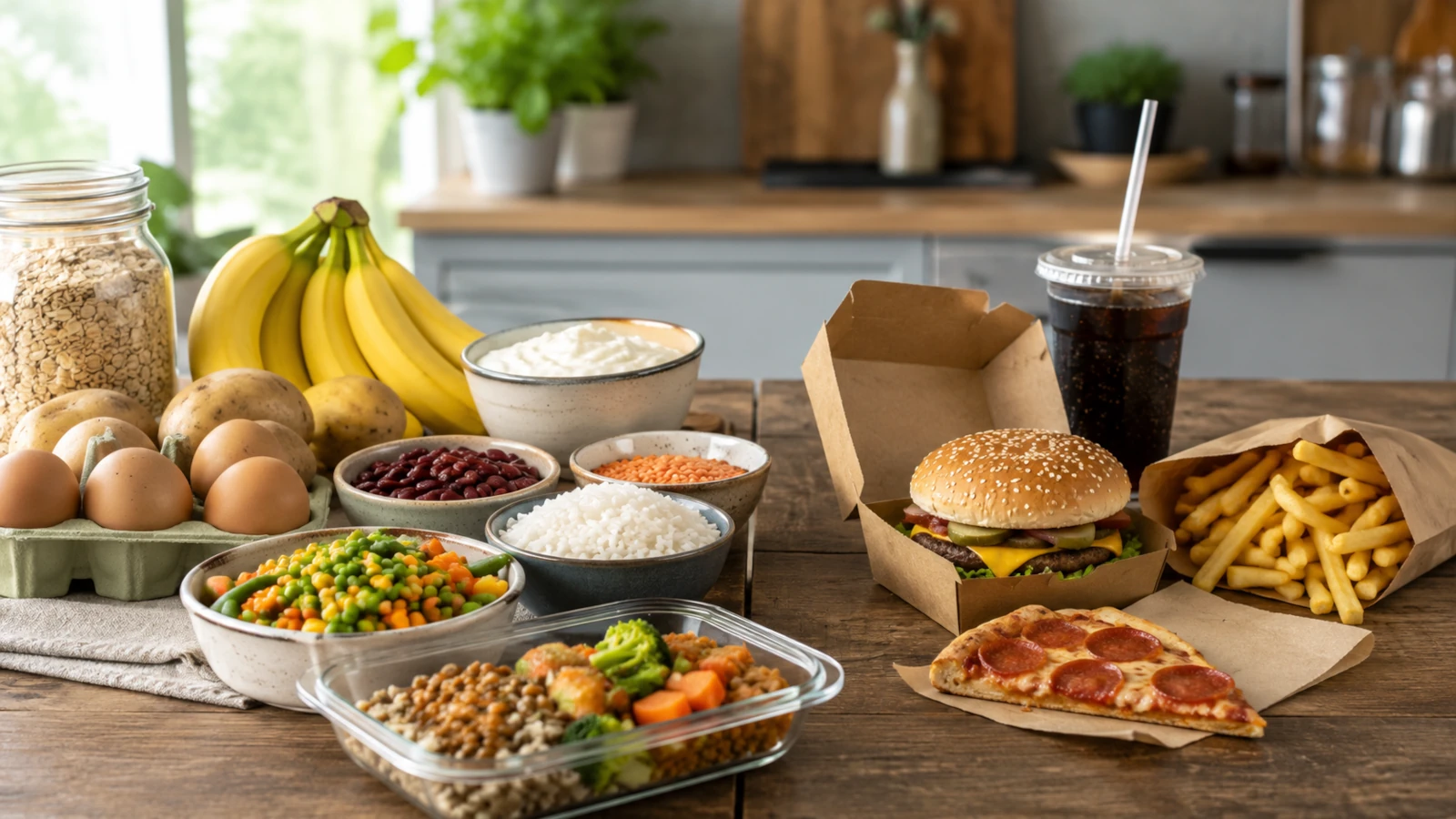
What does enough protein actually look like on your plate?Do you have to weigh everything? Does every meal need to be perfectly planned? Or can simple portion sizes help you get much closer to your daily protein goal?
The short answer: simple everyday estimates can be enough to get started. But if you want to lose fat, maintain muscle or build muscle in a targeted way, tracking is much more accurate.
This article shows simple protein portions, common mistakes and a practical example day with around 100 g of protein.
TL;DR
- Protein supports muscle maintenance, muscle growth and satiety.
- Many people do not miss their protein goal because they do not care — they miss it because they do not know simple portion sizes.
- Meat, fish, eggs, dairy products, legumes and protein products can all be useful protein sources.
- Hand-size portions and tablespoons can help in everyday life, but they are only rough estimates.
- Nuts and cheese contain protein, but they also contain a lot of calories and fat.
- For active people, around 1.4–2.0 g of protein per kg of body weight per day is often a useful orientation range.
- If you want to lose fat or maintain muscle, tracking is more accurate than guessing.
- Athletic-AI helps you keep an eye on protein goals, meals and repeatable foods.
Why eating enough protein is often harder than it sounds
On paper, the advice sounds simple: eat enough protein.In real life, it is not always that easy. Many meals are mostly built around bread, pasta, rice, potatoes, snacks or quick convenience foods. Those foods can still fit into a balanced diet, but protein often gets too little attention.
Typical everyday situations:
- Breakfast is mostly bread, jam, cereal or pastries.
- Lunch contains plenty of carbs but not much protein.
- Snacks add calories but very little protein.
- Dinner becomes the moment where you try to catch up on the whole day.
- Protein-rich foods are estimated incorrectly.
Eating enough protein becomes easier when you treat protein as a fixed building block of every meal.
How much protein do you need?
Your protein needs depend on body weight, goal, training and everyday activity.People without a specific athletic goal usually need less protein than fitness content often suggests. But if you lift weights, want to lose fat, maintain muscle or train regularly, protein becomes more important.
For active people, a common practical range is around 1.4 to 2.0 g of protein per kg of body weight per day.
Example for a 75 kg person:
- 1.4 g/kg = about 105 g protein per day
- 1.6 g/kg = about 120 g protein per day
- 2.0 g/kg = about 150 g protein per day
Simple protein portions without weighing everything
You do not have to weigh every meal perfectly to build a better feeling for protein.The following portions are rough everyday estimates. Exact values depend on the specific food, fat content, cooking loss, brand and preparation method.
1. Cooked meat or chicken: about half of your palm
A cooked portion of meat or chicken about the size of half of your palm is roughly around 90 g.Protein estimate: about 20–30 g
This can work for:
- chicken breast
- turkey breast
- lean beef
- lean pork
- lean ground meat
2. Cooked fish: about the size of your hand
A cooked fish portion about the size of your hand is roughly around 140 g.Protein estimate: about 25–35 g
Good examples:
- salmon
- cod
- pollock
- tuna
- trout
- shrimp
3. Eggs: 2–3 eggs
2–3 eggs are roughly around 120–180 g, depending on egg size.Protein estimate: about 14–22 g
Eggs are practical, versatile and easy to portion. But they do not only provide protein — they also provide fat. That makes them useful, but not a pure lean protein source.
4. Cheese: about the size of your index and middle fingers
A portion of cheese about the size of two fingers is roughly around 50 g.Protein estimate: about 10–15 g
Important: cheese is often overestimated as a protein source.
Yes, cheese contains protein. But many types of cheese also contain a lot of fat and calories. That makes cheese more of an additional protein source, not always the best main protein source during a diet.
5. Beans or lentils: about 4 tablespoons
4 tablespoons of cooked beans or lentils are roughly around 100–140 g.Protein estimate: about 7–13 g
Legumes provide less protein per 100 g than meat, fish or Greek yogurt. Still, they are valuable because they also provide fiber, carbohydrates and good satiety.
Good examples:
- lentils
- kidney beans
- black beans
- chickpeas
- peas
Related:
6. Nuts: about 3 tablespoons
3 tablespoons of nuts are roughly around 50 g.Protein estimate: about 8–12 g
Nuts contain protein, but they are mainly a fat and calorie source.
That is not bad. Nuts can absolutely fit into a healthy diet. But if your goal is fat loss, you should portion them consciously.
Nuts are healthy and practical, but they are not a low-calorie main protein source.
Protein portions at a glance
[table][tr][th]Food[/th][th]Everyday estimate[/th][th]Rough weight[/th][th]Rough protein[/th][/tr]
[tr][td]Cooked meat or chicken[/td][td]half of your palm[/td][td]about 90 g[/td][td]about 20–30 g[/td][/tr]
[tr][td]Cooked fish[/td][td]one hand-sized portion[/td][td]about 140 g[/td][td]about 25–35 g[/td][/tr]
[tr][td]Eggs[/td][td]2–3 eggs[/td][td]about 120–180 g[/td][td]about 14–22 g[/td][/tr]
[tr][td]Cheese[/td][td]two-finger-sized portion[/td][td]about 50 g[/td][td]about 10–15 g[/td][/tr]
[tr][td]Beans or lentils[/td][td]4 tablespoons[/td][td]about 100–140 g[/td][td]about 7–13 g[/td][/tr]
[tr][td]Nuts[/td][td]3 tablespoons[/td][td]about 50 g[/td][td]about 8–12 g[/td][/tr]
[/table]
This table is not a replacement for accurate tracking. But it helps you estimate meals faster.
How to reach 100 g of protein per day
100 g of protein per day can sound like a lot at first. But it becomes much easier when you spread it across the day.Example day with around 100 g of protein
Breakfast:250 g Greek yogurt, skyr or low-fat quark with fruit and oats
→ about 25–30 g protein
Lunch:
Chicken, fish or lean meat with rice, potatoes or vegetables
→ about 25–35 g protein
Snack:
2 eggs, a protein shake or another portion of Greek yogurt
→ about 15–25 g protein
Dinner:
Lentils, beans, eggs, fish, tofu, meat substitute or another protein-rich component
→ about 20–30 g protein
Total:
about 90–120 g protein
The trick is not to eat one huge protein meal. The trick is to spread protein across the day.
If you start every meal with a protein source, reaching your daily target becomes much easier.
Does every meal need a lot of protein?
Not necessarily. But it helps.If breakfast contains almost no protein, lunch contains little protein and dinner has to fix the whole day, eating enough protein becomes harder than necessary.
A more practical approach:
- Breakfast: 20–30 g protein
- Lunch: 25–40 g protein
- Snack: 10–25 g protein
- Dinner: 25–40 g protein
Practical repeatable meals include:
- Greek yogurt or quark with fruit
- eggs with bread or potatoes
- chicken rice bowl
- tuna wrap
- lentil bowl
- tofu vegetable stir-fry
- protein pancakes
Good protein sources for everyday life
Good protein sources are not only foods with a lot of protein. They also have to fit your everyday life.Very protein-rich and easy
- chicken breast
- turkey breast
- lean beef
- tuna
- shrimp
- Greek yogurt
- skyr
- low-fat quark
- cottage cheese
- whey or vegan protein powder
Protein-rich, but higher in calories
- salmon
- eggs
- cheese
- nuts
- nut butter
- higher-fat ground meat
Plant-based protein sources
- tofu
- tempeh
- lentils
- beans
- chickpeas
- peas
- soy yogurt
- seitan
Common mistakes when trying to eat enough protein
Mistake 1: Only planning protein at dinner
If you eat very little protein during the day, dinner has to do too much. It is easier to include a protein source in every main meal.Mistake 2: Overestimating nuts
Nuts provide protein, but also many calories. 50 g of nuts can add a lot of energy without providing a particularly high protein amount.Mistake 3: Treating cheese as a light protein source
Cheese can provide protein, but it is often high in fat and calories. Small amounts can fit well, but it is not always the best main protein source.Mistake 4: Underestimating legumes
Lentils and beans provide less protein per 100 g than meat or Greek yogurt, but they are filling and bring fiber. For budget-friendly nutrition, they can be very useful.Mistake 5: Only focusing on protein
Protein matters, but it is not everything. Calories, fiber, vegetables, fruit, training, sleep and movement still matter too.Mistake 6: Estimating everything and never checking
Estimating is better than having no feeling at all. But if you do not reach your goal for weeks, you need more accurate data.What is better: weighing or estimating?
Both can be useful.Estimating is useful when you want to start
Hand sizes, tablespoons and simple portion rules help you build a feeling quickly. Especially at the beginning, this is better than changing nothing at all.Weighing is better when you have a specific goal
If you want to lose fat, maintain muscle or measure progress more accurately, tracking is more reliable.Foods that are especially useful to weigh include:
- oil
- nuts
- cheese
- nut butter
- cereal
- rice and pasta
- high-calorie sauces
- snacks
Estimating helps you start. Tracking helps you stay in control.
Eating enough protein for fat loss
If you want to lose fat, protein can be especially helpful.Why?
- Protein supports muscle maintenance.
- Protein can make meals more filling.
- Protein can make a diet easier to stick to.
- Protein-rich meals often reduce random snacking.
You can eat a lot of protein and still gain weight if total calories are too high. Protein is a tool, not a free pass.
For fat loss, the combination matters:
- moderate calorie deficit
- enough protein
- strength training
- enough steps
- realistic meals
- realistic portion sizes
Eating enough protein for muscle gain
For muscle gain, you do not only need protein. You also need training and enough energy.Protein provides building blocks. Strength training provides the stimulus. Calories and recovery help your body turn that stimulus into progress.
A good muscle gain diet usually includes:
- regular protein across the day
- enough total calories
- enough carbs for training
- not too little fat
- consistent strength training
- enough sleep and recovery
Related:
How Athletic-AI helps with your protein goal
Estimating protein in your head is possible. But in everyday life, it is easy to lose track.With Athletic-AI, you can:
- calculate your protein target based on your goal and body data
- see protein, calories, fat and carbs in your diary
- add repeatable meals faster
- save your own foods
- use recipes with portions
- plan high-protein meals more easily
- see whether you actually reached enough protein by the end of the day
You do not have to make nutrition perfect. But you should know whether your daily habits actually fit your goal.
Conclusion: eating enough protein becomes easier when you understand portions
Eating enough protein does not have to be complicated.Simple everyday portions can help:
- Meat or chicken: about half of your palm
- Fish: about one hand-sized portion
- Eggs: 2–3 eggs
- Cheese: about two fingers
- Beans or lentils: about 4 tablespoons
- Nuts: about 3 tablespoons, but more as an addition
If you have specific goals, tracking is more accurate. Especially for fat loss, muscle maintenance and muscle gain, it is worth checking protein and calories regularly instead of only guessing.
The best practice is:
Use simple portion sizes for everyday life — and tracking when you really want to know whether you are reaching your goal.
FAQ: eating enough protein every day
How can I eat enough protein every day?
Plan a protein source with every main meal. Good options include Greek yogurt, skyr, quark, eggs, fish, meat, tofu, lentils, beans or protein powder as a supplement.Is 100 g of protein per day a lot?
That depends on body weight and goal. For many active people, 100 g of protein per day is a realistic and useful range. For others, it may be too much or too little.What does one protein portion look like?
Roughly: half a palm of cooked meat, one hand-sized portion of fish, 2–3 eggs, 250 g Greek yogurt or 4 tablespoons of lentils or beans can all be useful protein building blocks.Can I get enough protein without meat?
Yes. Plant-based options include tofu, tempeh, lentils, beans, chickpeas, seitan, soy yogurt or vegan protein powder.Are nuts a good protein source?
Nuts contain protein, but they also contain a lot of fat and calories. They are better used as an addition than as a main protein source.Is cheese a good protein source?
Cheese can provide protein, but it is often high in calories and fat. Depending on your goal, you should plan the portion consciously.Do I have to weigh my food?
Not necessarily. Simple portion sizes are enough to get started. If you want to lose fat, maintain muscle or measure progress more accurately, weighing and tracking are more precise.When should I eat protein?
The easiest approach is to spread protein across the day: breakfast, lunch, snack and dinner. That way, you do not have to catch up everything at night.Sources and further reading
- International Society of Sports Nutrition Position Stand: Protein and Exercise
- Morton et al. – Protein supplementation and resistance training: systematic review and meta-analysis
- DGE – Reference values for protein
- EFSA – Scientific Opinion on Dietary Reference Values for protein