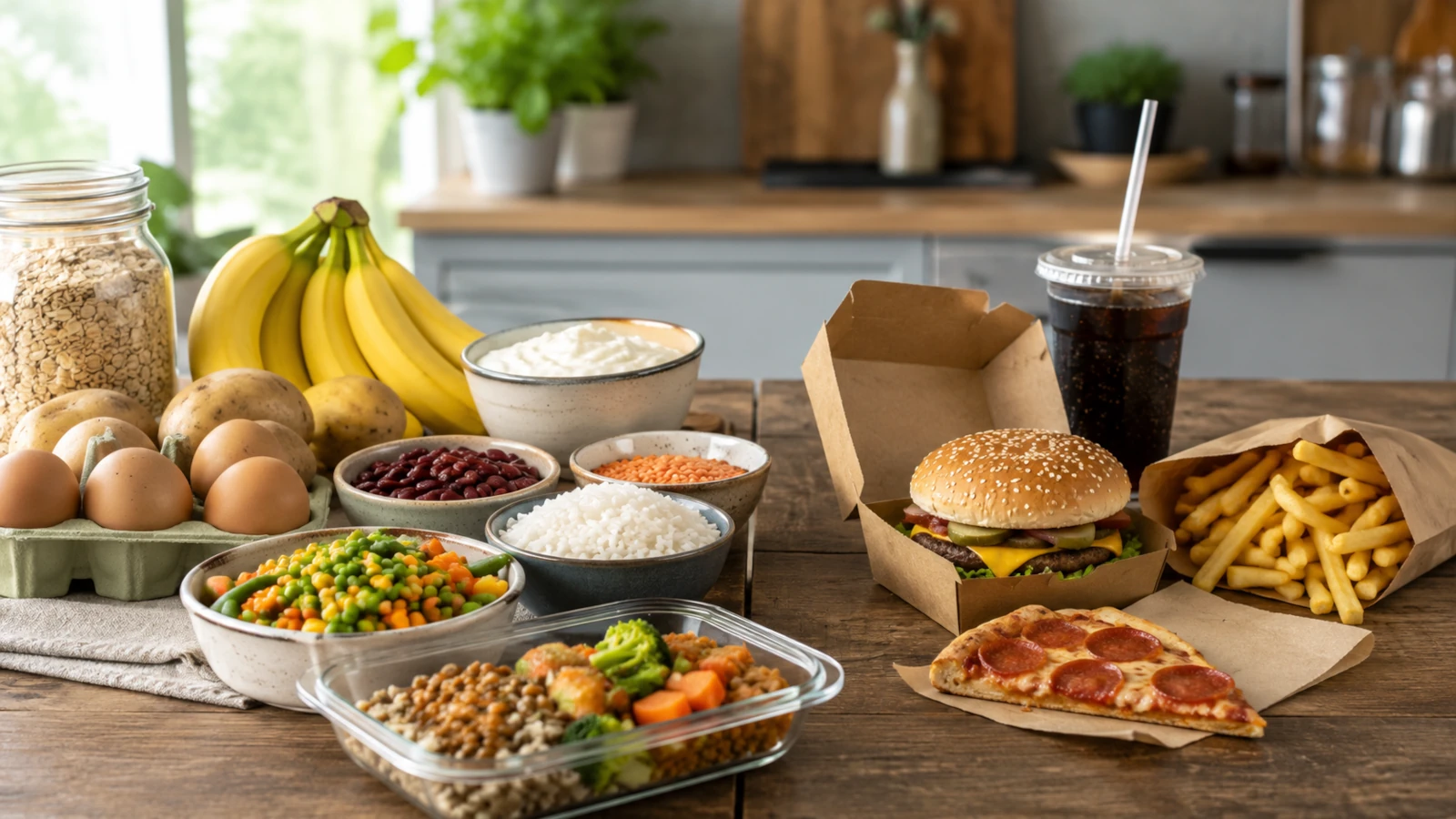

If your goal is fat loss, low carb, keto or simply better food choices, fiber is worth understanding. It affects not only digestion, but also how filling a meal feels and how carbohydrates are interpreted in practice.
In short: fiber is not useless filler. It supports your gut, your satiety and often your diet consistency.
Quick summary
- Fiber is mostly indigestible or only partly digestible carbohydrate.
- It is mainly found in plant foods.
- It supports bowel function, stool bulk, satiety and sometimes the blood sugar response to meals.
- The German Nutrition Society uses at least 30 g per day as a guideline for adults.
- EFSA considers 25 g per day adequate for normal bowel function in adults.
- Good sources include whole grains, legumes, vegetables, fruit, nuts and seeds.
- Increasing fiber too fast can cause bloating, pressure or digestive discomfort.
- Net carbs are often simplified as total carbs minus fiber.
- For Athletic-AI, fiber, sugar alcohols and regular carbohydrates should be tracked separately in the long run.
1) What is fiber?
Fiber is made up of food components that your body cannot fully digest and absorb. It belongs broadly to the carbohydrate family, but it behaves differently from sugar or starch.Regular carbohydrates can be broken down and used as energy. Fiber passes through the small intestine fully or partly unchanged and has most of its effects in the digestive tract.
Fiber is mainly found in:
- whole-grain products
- oats and oat bran
- legumes such as lentils, beans and chickpeas
- vegetables
- fruit and berries
- nuts
- seeds such as flaxseed, chia and psyllium husk
- mushrooms
2) Soluble and insoluble fiber
Fiber is often roughly divided into soluble and insoluble fiber.Soluble fiber:
- can bind water
- can form gel-like structures
- can slow digestion
- can influence the blood sugar response to a meal
- can be fermented by gut bacteria
- is found for example in oats, legumes, fruit, vegetables, psyllium and pectin
- often increases stool bulk
- supports bowel movement
- is usually fermented less strongly
- is found for example in whole grains, bran, skins and vegetables
3) Why fiber matters for your gut
Fiber affects digestion in several ways. It can bind water, increase stool volume, support bowel movement and feed certain gut bacteria.It can help with:
- regular digestion
- normal stool volume
- better stool consistency
- bowel movement
- feeding certain gut bacteria
- production of short-chain fatty acids through fermentation
But that does not mean “more is always better”. If you currently eat very little fiber and suddenly increase it aggressively, your gut may complain.
Fiber is useful — but your gut prefers gradual adaptation, not a surprise attack.
4) Fiber and satiety
Fiber can be very helpful during fat loss because it can make meals more filling.This is not magic. It happens through practical effects:
- high-fiber foods often have more volume
- you usually chew longer
- meals may stay longer in the digestive tract
- the combination of protein, fiber and water can make meals much more filling
- depending on the meal, blood sugar swings may be reduced
Related article: Volume eating: how to feel full with fewer calories
5) How much fiber per day?
A common practical guideline for adults is at least 30 g of fiber per day. The German Nutrition Society confirms this adult guideline. EFSA considers 25 g per day adequate for normal bowel function in adults and also points to possible health benefits at higher intakes.In practice, you do not have to hit the exact same number every day. A stable average over several days matters more.
Rough orientation:
- below 15 g per day: usually rather low
- 15–25 g per day: better, but often still improvable
- 25–35 g per day: a useful range for many adults
- much higher: can work, but tolerance is individual
6) Good everyday fiber sources
You do not need to change your entire diet immediately. Small additions often work well.Simple fiber boosters:
- oats or oat bran at breakfast
- berries with skyr, quark or yogurt
- lentils, beans or chickpeas in bowls, stews or salads
- a vegetable portion with lunch or dinner
- small amounts of flaxseed or chia seeds
- whole grains instead of white flour, if you like and tolerate them
- potatoes, legumes or vegetables as filling side dishes
- skyr with berries, oats and flaxseed
- chili with beans, tomatoes, vegetables and lean meat or soy mince
- potatoes with herb quark and vegetables
- lentil soup with extra vegetables
- chicken vegetable pan with rice or potatoes
- whole-grain wrap with salad, vegetables and a protein source
The best fiber plan is not the perfect plan. It is the one you actually repeat.
7) Fiber, low carb and keto
In low carb and keto diets, carbohydrates are often reduced strongly. This can create confusion because fiber may also appear under carbohydrates.The important point: fiber does not behave like regular sugar or starch. That is why many low-carb and keto approaches use net carbs.
Related article: Low carb: useful or unnecessary?
What are net carbs?
Net carbs are a simplified way to estimate the carbohydrates that matter most for low carb or keto.A simple formula is:
Net carbs = carbohydrates – fiberExample:
- 20 g carbohydrates
- 8 g fiber
20 g – 8 g = 12 g net carbs
This sounds simple, but it is not always perfect. Food labeling, country rules, fiber types and sugar alcohols can make the calculation more complicated.
8) Be careful with sugar alcohols and “sugar-free” products
Many sugar-free bars, protein bars, sweets and keto products use not only fiber, but also sugar alcohols.Examples include:
- erythritol
- maltitol
- xylitol
- sorbitol
- isomalt
Very important: maltitol is not the same as erythritol. Still, both can be marketed in a similar way.
Related articles:That is why Athletic-AI should not only show “carbohydrates” in the long run, but separate:
- total carbohydrates
- sugar
- fiber
- polyols / sugar alcohols
- net-carb calculation
9) Fiber does not automatically mean calorie-free
Fiber often provides less usable energy than regular carbohydrates. Still, high-fiber products are not automatically calorie-free.This matters especially with processed products.
A protein bar can contain a lot of fiber and still be high in calories because it also contains fat, nuts, chocolate, polyols or other ingredients.
Remember:
- fiber can be useful
- fiber does not automatically make a product low calorie
- fat loss still depends on energy balance
- satiety depends on the whole meal, not one single nutrient
The foundation is explained here: Calorie deficit explained simply
10) What happens if you increase fiber too fast?
More fiber can be useful for many people. But if you jump from very little to very much, it can feel uncomfortable.Common issues with a sudden increase:
- bloating
- abdominal pressure
- feeling overly full
- diarrhea
- constipation
- digestive rumbling
Better approach:
- increase gradually
- drink enough
- test different sources
- introduce legumes slowly
- dose psyllium carefully
- do not add several new fiber sources at the same time
11) Fiber and protein: a strong fat-loss combination
Fiber alone is not everything. It becomes especially powerful in combination with protein.Protein supports satiety and muscle maintenance. Fiber supports volume, digestion and meal structure. Together, they can make a calorie deficit much easier to maintain.
A good fat-loss meal often contains:
- a clear protein source
- a high-fiber component
- enough volume
- a controlled fat source
- a carbohydrate amount that fits the goal
Example 2: quark or skyr with berries, oats and some flaxseed
Example 3: lentil bolognese with vegetables and a suitable portion of pasta
Example 4: omelet with vegetables, salad and some whole-grain bread
Related article: Why protein is so important
For calculating your own intake, this also fits: How to calculate your protein needs
12) Practical shopping list for more fiber
If you want to eat more fiber, a simple shopping list helps.For breakfast and snacks:
- oats
- oat bran
- berries
- flaxseed
- chia seeds
- skyr, quark or yogurt as a protein base
- potatoes
- lentils
- beans
- chickpeas
- broccoli
- carrots
- bell peppers
- zucchini
- spinach
- whole-grain pasta or rice, if you like them
- frozen vegetables
- canned tomatoes
- kidney beans
- canned chickpeas
- sauerkraut or fermented vegetables, if you tolerate them
- small amounts of psyllium husk
13) Common fiber mistakes
Mistake 1: Going from 0 to 100
If you suddenly eat a lot of whole grains, legumes, seeds and psyllium, your gut may react badly. Increase slowly.Mistake 2: Drinking too little
Some fibers bind water. If you eat much more fiber but barely drink, it can feel uncomfortable.Mistake 3: Only using bars and special products
High-fiber bars can be practical, but they do not automatically replace vegetables, fruit, legumes and whole grains.Mistake 4: Making net carbs look too good
Not every “low carb” product is automatically good for fat loss. Calories, fat, portion size and tolerance still matter.Mistake 5: Thinking fiber replaces protein
Fiber helps satiety. For muscle maintenance and fitness goals, protein is still important.14) Fiber and scale weight fluctuations
If you strongly change your fiber intake, your scale weight can also change in the short term. More fiber often means more food volume, more water binding and more content in the digestive tract.That is not automatically fat gain. It can simply be digestive content and water.
A similar thing happens with carbohydrates and glycogen. If you reduce or increase carbohydrates, your weight can move quickly without a matching change in body fat.
Related article: Carbs and water weight: why the scale fluctuates
15) How Athletic-AI could use fiber intelligently
For a fitness and nutrition app, fiber is more than just an extra number.Useful long-term features could include:
- showing fiber separately for foods
- calculating net carbs
- tracking polyols separately
- giving hints when fiber intake is very low
- rating meals more realistically for satiety
- making low-carb and keto ratings more accurate
- showing which recipe ingredients contribute fiber
- explaining in coaching why some meals keep users full longer
In practice, it is not only about how many calories a meal has. It is also about how long it keeps you full.
Related articles
- Volume eating: how to feel full with fewer calories – explains why water, volume and fiber can be so helpful during fat loss.
- Calorie deficit explained simply – the foundation for why fat loss still depends on energy balance.
- Why protein is so important – useful because protein and fiber together support satiety especially well.
- Low carb: useful or unnecessary? – puts net carbs, low carb and everyday practicality into context.
- Sweeteners: what is actually true? – adds context for sweeteners and light products.
- Sugar-free does not mean calorie-free – important for bars, polyols and supposedly keto-friendly snacks.
- Carbs and water weight – explains why weight can fluctuate because of carbohydrates, water and digestion.
FAQ
“Is fiber a carbohydrate?”Yes, broadly speaking. But it is not digested and used like sugar or starch.
“Do I have to hit exactly 30 g per day?”
No. 30 g is a useful guideline for adults. Your average intake and tolerance matter more than a perfect number every day.
“Are net carbs always accurate?”
No. Net carbs are a practical simplification, but fiber type, sugar alcohols, labeling and individual response can make a difference.
“Can I just take fiber powder?”
It can be used as an addition, for example psyllium husk. But a base of normal foods such as vegetables, legumes, fruit, whole grains and seeds is usually better.
“Why do I get bloated from fiber?”
Often because the increase was too fast, legumes are unfamiliar or certain fermentable fibers do not fit you well. Increasing gradually often helps.
“Is fiber important for fat loss?”
It does not create fat loss directly. But it can improve satiety, meal volume and diet consistency. That often makes a calorie deficit easier to maintain.
Bottom line: fiber is an underrated fitness lever
Fiber is not only a digestion topic. It can make meals more filling, support your gut and help you interpret carbohydrates more realistically.For fat loss, low carb, keto and everyday nutrition, it is more important than many people think.
You do not have to eat perfectly. Start simple:
- one more portion of vegetables
- some berries with quark or yogurt
- oats or oat bran at breakfast
- lentils, beans or chickpeas regularly
- increase slowly
- drink enough
Sources
- German Nutrition Society – Questions and answers on dietary fiber
- German Nutrition Society – Reference values for fiber
- EFSA – Dietary reference values for nutrient intakes
- European Commission / Knowledge4Policy – Dietary fibre recommendations