This question sounds simple, but it is often made unnecessarily complicated: the perfect gram amount, perfect timing, perfect protein source, shake or no shake, morning or evening, before or after training.
The truth is much more relaxed:
For most people, the first priority is not perfection. It is a stable daily protein intake that fits the goal.Protein is especially important for muscle maintenance, muscle gain, satiety and recovery. But you do not need to turn it into a science project. A simple formula is enough for everyday use.
Quick summary: the key points
- For many active people, around 1.6–2.2 g of protein per kg body weight per day is a useful range.
- For muscle gain, around 1.6–2.0 g/kg is often enough.
- During fat loss or when body fat is already low, the upper range can be useful.
- If you are very overweight, goal weight or lean mass may be a better reference than current body weight.
- Spread protein across 3–4 meals per day.
- Protein shakes are practical, but not required.
- Reaching your daily amount consistently matters more than perfect timing.
1) Why protein matters
Protein is not only important for bodybuilders. Your body uses protein as a building material for muscles, tissue, enzymes, hormones, immune function and recovery.For fitness, fat loss and muscle gain, three points are especially important:
- Muscle maintenance: Especially in a calorie deficit, protein can help protect existing muscle mass.
- Muscle gain: After training, your body needs amino acids to repair and build muscle protein.
- Satiety: Protein-rich meals often keep people full for longer and can help reduce cravings.
Training provides the stimulus. Protein provides the building material. Recovery turns it into progress.
2) The simple formula
The easiest formula is:Body weight in kg × protein factor = daily protein targetThe protein factor depends on your goal.
- Healthy active lifestyle: around 1.2–1.6 g/kg
- Muscle gain: around 1.6–2.0 g/kg
- Fat loss with strength training: around 1.6–2.2 g/kg
- Hard diet / very low body fat: usually toward the upper range
2.0 g protein per kg body weight per dayIt is easy to calculate, lands in a useful range and works well for many goals.
Try it directly: protein calculator
If you do not want to calculate it manually, you can use the Athletic-AI protein calculator. Enter your weight and goal to get a quick daily protein guideline.Important: the calculator is meant as a simple everyday helper. If you are very overweight, using a realistic goal weight as orientation may be more useful than calculating strictly with your current body weight. There is a practical example below.
3) Examples
Example 1: 70 kg body weight
- 1.6 g/kg → 112 g protein per day
- 1.8 g/kg → 126 g protein per day
- 2.0 g/kg → 140 g protein per day
- 2.2 g/kg → 154 g protein per day
Example 2: 80 kg body weight
- 1.6 g/kg → 128 g protein per day
- 1.8 g/kg → 144 g protein per day
- 2.0 g/kg → 160 g protein per day
- 2.2 g/kg → 176 g protein per day
Example 3: 100 kg body weight
- 1.6 g/kg → 160 g protein per day
- 1.8 g/kg → 180 g protein per day
- 2.0 g/kg → 200 g protein per day
- 2.2 g/kg → 220 g protein per day
4) What if you are very overweight?
If you are very overweight, using current body weight can lead to very high protein numbers.Example:
- 130 kg body weight × 2.0 g = 260 g protein per day
In that case, it is often more practical to use a realistic goal weight or lean mass if known.
Practical example
Current weight: 130 kgRealistic goal weight: 95 kg
- 95 kg × 1.8 g = around 171 g protein per day
- 95 kg × 2.0 g = around 190 g protein per day
The higher the body fat percentage, the more useful goal weight can be as the reference point.
5) Protein for muscle gain
For muscle gain, you do not need endless protein. More protein does not automatically mean more muscle.Muscle gain mainly depends on:
- regular strength training
- progressive overload over time
- enough protein
- enough calories
- sleep and recovery
around 1.6–2.0 g protein per kg body weight per dayIf you weigh 80 kg, around 130–160 g protein per day is already a very solid target.
More can be fine if it helps you stay full or structure your diet, but it is not automatically better for muscle growth.
6) Protein for fat loss
Protein becomes especially important during a diet.Why?
Because your body has to deal with less energy. If the training stimulus is missing, the deficit is too aggressive and protein is too low, the risk of losing muscle mass increases.
Protein helps during fat loss with:
- muscle maintenance
- satiety
- recovery
- better meal structure
- fewer cravings
around 1.6–2.2 g protein per kg body weight per dayThe harder the diet, the lower the body fat and the more important muscle maintenance is, the more the upper range can make sense.
Example
You weigh 75 kg and want to lose fat.- 75 × 1.6 = 120 g protein per day
- 75 × 2.0 = 150 g protein per day
- 75 × 2.2 = 165 g protein per day
7) How to spread protein across the day
You do not need perfect timing. For most people, spreading the daily amount across a few meals works best.Simple everyday shortcut
- 3 meals per day: around 30–50 g protein per meal
- 4 meals per day: around 25–40 g protein per meal
- 2 meals per day: possible, but often harder because each meal has to be very high in protein
- breakfast: 40 g
- lunch: 45 g
- snack or shake: 25 g
- dinner: 40 g
The best protein plan is the one you can repeat without stress.
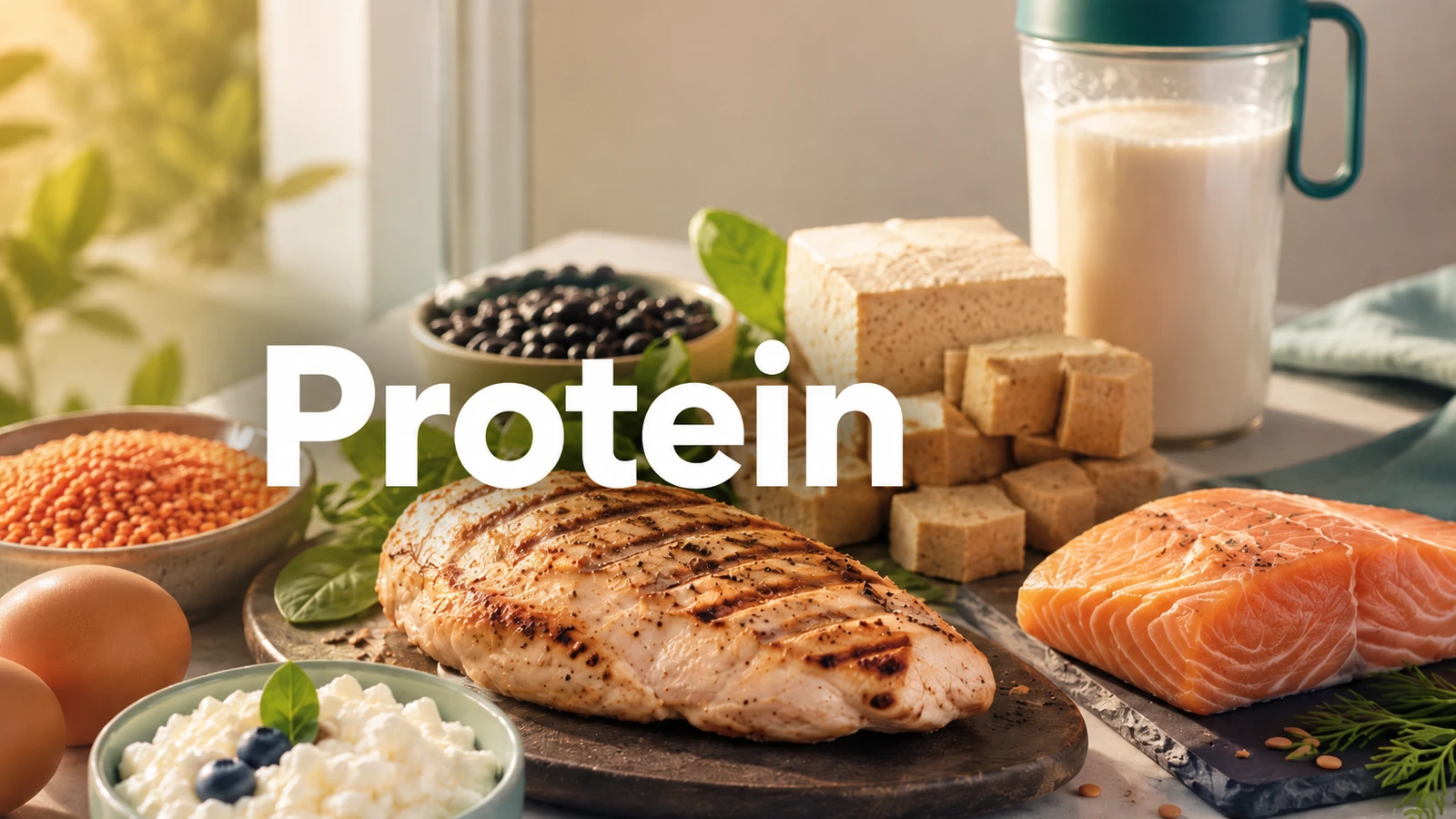
8) Good protein sources
Protein does not have to be complicated. You do not need perfect fitness foods. The main thing is that each meal has a clear protein source.If you want to go deeper, read the follow-up article The best protein sources: which foods provide good protein?. It explains animal-based and plant-based protein sources, shakes, skyr, eggs, tofu, legumes and meal prep in more detail.
Animal-based protein sources
- Skyr
- low-fat quark
- Greek yogurt
- cottage cheese
- eggs
- chicken
- turkey
- lean beef
- fish
- shrimp
- tuna
Plant-based protein sources
- tofu
- tempeh
- seitan
- lentils
- beans
- chickpeas
- high-protein soy yogurt
- pea protein
- rice protein
- soy protein
Practical additions
- whey protein
- casein
- vegan protein powder
- protein bars if they fit your calories
9) Example day with around 150 g protein
A simple day could look like this:Breakfast
Skyr with oats and berries- around 35–45 g protein
Lunch
Chicken with rice and vegetables- around 40–50 g protein
Snack
Protein shake or low-fat quark- around 25–35 g protein
Dinner
Eggs, fish, tofu or lean meat with a side- around 35–45 g protein
10) Common mistakes
- Too little protein in the morning: If breakfast and lunch are low in protein, the evening becomes difficult.
- Overestimating protein: A little cheese, nuts or yogurt does not automatically make a meal high-protein.
- Only relying on shakes: Shakes are practical, but normal foods should be the foundation.
- Lowering protein during a diet: This is exactly when protein becomes more important.
- Making the calculation too complicated: A useful range is better than a perfect number you never hit.
- Forgetting calories: Protein has calories too. More protein does not replace a sensible calorie target.
11) Do you need protein right after training?
No, you do not need to panic-drink a shake immediately after your last set.The total daily amount matters more. Still, a protein-rich meal around training can be practical.
A simple approach:
- Eat a normal meal with protein 1–3 hours before training.
- Or eat a protein-rich meal after training.
- If timing does not work out perfectly, it is not a disaster.
Protein timing can optimize. The daily amount matters much more.
12) Is too much protein harmful?
For healthy people, moderate to higher protein intakes in the fitness range are usually not a problem.Still:
- More protein is not automatically better.
- Extremely high amounts are often unnecessary.
- If you have kidney disease or other medical limitations, you should discuss your protein intake with a doctor.
13) Planning protein with Athletic-AI
You can calculate protein manually. For a quick starting point, you can also use the protein calculator. It becomes even more useful when you check your nutrition in everyday life.With Athletic-AI, you can track nutrition, calories and macros more clearly. This helps you see whether you are reaching your protein target or whether certain meals are too low in protein.
This is especially useful if you want to:
- build muscle
- lose fat
- plan meals more easily
- check protein instead of guessing it
- bring more structure into your nutrition
What you track regularly, you can improve more deliberately.
FAQ
How much protein do I need per day?For many active people, around 1.6–2.2 g per kg body weight per day is a useful range.
Is 1.6 g protein per kg enough?
For muscle gain, it can be enough for many people. During fat loss or at very low body fat, slightly more can be useful.
Is 2 g protein per kg too much?
For healthy, active people, it is usually a normal and practical target. If you have medical limitations, ask a doctor.
Should I calculate with current weight or goal weight?
If you are normal-weight or athletic, current body weight works well. If you are very overweight, goal weight is often more practical.
Do I need protein powder?
No. Protein powder is just a practical tool. You can reach your protein target with normal foods.
Is plant protein worse?
Not automatically. A high-protein plant-based diet can work well, but you should plan your sources more consciously.
Do I need protein immediately after training?
Not exactly. The daily amount matters more. A meal around training can be useful, but it is not mandatory.
Bottom line
Calculating your protein needs does not have to be complicated.For most fitness goals, this simple orientation works well:
- Muscle gain: around 1.6–2.0 g/kg body weight
- Fat loss: around 1.6–2.2 g/kg body weight
- Very overweight: calculate with goal weight or lean mass instead
Build a clear protein source into every main meal. This makes your daily target much easier to reach.Protein is not magic. But it is one of the simplest and most effective levers for muscle maintenance, muscle gain, satiety and better nutrition control.
Sources and further reading
- Morton et al. (2018) – Protein supplementation and resistance training: meta-analysis
- Jäger et al. (2017) – International Society of Sports Nutrition position stand: protein and exercise
- Helms et al. (2014) – Protein needs in energy-restricted phases
- Helms et al. (2014) – Evidence-based recommendations for natural bodybuilding contest preparation